Workplace Schadenfreude and Competitive Culture: A Quantitative Study of Social Comparison, Emotion, and Organizational Consequences
DOI:
https://doi.org/10.5281/zenodo.21726033Keywords:
schadenfreude, workplace, social comparison, competitive climate, envy, moral emotionsAbstract
This study examines workplace schadenfreude—the experience of pleasure derived from colleagues’ professional failures—and its psychological and organizational consequences through a quantitative investigation of employees operating in competitive organizational environments. The sample comprises 100 employees assessed for frequency, triggers, and outcomes of schadenfreude experiences within workplace interactions. Grounded in Social Comparison Theory (Festinger, 1954) and Intergroup Emotion Theory (Mackie et al., 2000), the research explores the cognitive, emotional, and structural mechanisms that give rise to this phenomenon in organizational settings. Findings indicate that 54% of employees report experiencing schadenfreude at a colleague’s professional setback at least occasionally, suggesting that the emotion is relatively common in competitive work environments. Multiple predictors were identified. A highly competitive organizational climate emerged as a strong predictor (β = 0.34), followed by prior envy toward the target (β = 0.30), perceived arrogance of the colleague (β = 0.24), and the presence of zero-sum reward structures (β = 0.22). These variables collectively explain 42% of the variance in schadenfreude frequency, highlighting the role of both dispositional and structural factors. While schadenfreude is associated with a temporary increase in self-reported morale (M = 3.42), it also generates negative interpersonal consequences. Experiencing schadenfreude is significantly correlated with long-term deterioration in workplace relationships (r = 0.44) and reduced willingness to engage in collaborative work (r = −0.48), indicating that its short-term affective benefits are offset by relational costs. The findings suggest that schadenfreude functions as an emotionally reinforcing but socially disruptive response within competitive organizational cultures. The study contributes to behavioral science and organizational psychology by clarifying the antecedents and consequences of schadenfreude in workplace settings and offers practical implications for organizational design, leadership practices, and the management of competitive work environments.
References
Aftab, M., Syed, K. B. S., & Katper, N. A. (2017). Exchange-rate volatility and Malaysian-Thai bilateral industry trade flows. Journal of Economic Studies, 44(1), 99-114.
Ahmed, J., Rafique, M. O., Qureshi, A., Shamsuddin, P., & Abd Wahab, D. S. (2024). Bridging the Gap: Exploring the Role of Green Transformational Leadership in Fostering Sustainability in the Islamic Banking Industry.
Ahmed, N., Hamid, Z., Mahboob, F., Rehman, K. U., Ali, M. S. E., Senkus, P., ... & Skrzypek, A. (2022). Causal linkage among agricultural insurance, air pollution, and agricultural green total factor productivity in United States: pairwise granger causality approach. Agriculture, 12(9), 1320.
Ahmed, N., Mahboob, F., Hamid, Z., Sheikh, A. A., Ali, M. S. E., Glabiszewski, W., ... & Cyfert, S. (2022). Nexus between nuclear energy consumption and carbon footprint in Asia Pacific region: Policy toward environmental sustainability. Energies, 15(19), 6956.
Ahmed, N., Sheikh, A. A., Mahboob, F., Ali, M. S. E., Jasińska, E., Jasiński, M., ... & Burgio, A. (2022). Energy diversification: a friend or foe to economic growth in Nordic countries? A novel energy diversification approach. Energies, 15(15), 5422.
Ahmed, S., Jabeen, R., & Khan, D. S. (2023). Mediating Role of Leadership Self-Efficacy between Formal Developmental Experiences and Leadership Effectiveness: In Pakistani Higher Education Institutions. Siazga Research Journal, 2(3), 140–146. https://doi.org/10.58341/srj.v2i3.19
Al Asbahi, A. A. M. H., Fang, Z., Chandio, Z. A., Tunio, M. K., Ahmed, J., & Abbas, M. (2020). Assessing barriers and solutions for Yemen energy crisis to adopt green and sustainable practices: A fuzzy multi-criteria analysis. Environmental Science and Pollution Research, 27(29), 36765-36781.
Bibi, M., Khan, M. K., Tufail, M. M. B., Godil, D. I., Usman, R., & Faizan, M. (2023). How ICT and globalization interact with the environment: a case of the Chinese economy. Environmental Science and Pollution Research, 30(3), 8207-8225.
Chhajro, M., Khuhro, M., Kumar, K., Wagan, A., Umrani, A., & Laghari, A. (2020). Multi-text classification of Urdu/Roman using machine learning and natural language preprocessing techniques. Indian J. Sci. Technol, 13, 1890-1900. https://doi.org/10.17485/ijst/v13i19.230
Ghani, H., Khan, C., Miraj, J., & Shaikh, J. A. (2023). GREEN MARKETING AND ITS IMPACT ON CONUSMER PURCHASING BEHAVIOR OF BALOCHISTAN. THE ASIAN BULLETIN OF GREEN MANAGEMENT AND CIRCULAR ECONOMY, 3(1), 122-142.
Habil, H. (2013). Technical oral presentation: Analyzing communicative competence of Engineering students of Pakistan for workplace environment. Research on Humanities and Social Sciences.
Hafeez, A., Wagan, A. A., Umrani, A. I., & Javed, S. (2021). Ontology-Based Transformation and Verification of UML/OCL Constraints. Sukkur IBA Journal of Computing and Mathematical Sciences, 5(2), 36-40.
Hureri, M. A., Rafique, M. O., & Yousufi, A. R. (2021). The development of spouse in the light of Holy Prophet Muhammad (PBUH)’s relation with Sayyedah Aisha (R.A). Al-Aijaz Research Journal of Islamic Studies & Humanities. https://doi.org/10.53575/URDU5.V5.02(21).53-73
Hureri, M. A., Rafique, M. O., Alia, K., Ullah, M. Z., Ahmad, M., & Majid, A. (2022). Holistic Islamic Model for Securing Wealth in Light of Maqasid-E-Shariah. Al-Qanṭara, 8(2).
Hussain, A., Ahmad, J., Altaf, Y., Khan, M., & Sanghi, A. (2016). A study on various attributing reasons for switching telecommunication brands among various cellular services at Larkana, Sindh, Pakistan. Finance and Management Sciences, 11(1), 36-83.
Johl, S. K., Umrani, A. I., & Munodawafa, R. T. (2017, November). A comparative study of active learning with and without using mind mapping approach. In 2017 7th World Engineering Education Forum (WEEF) (pp. 839-843). IEEE. https://doi.org/10.1109/WEEF.2017.8467158
Kakepoto, I., Bhutto, N. A., & Umrani, A. I. (2022). Biometric attendance management system: A university perspective. Global Social Sciences Review, VII, 309-318. http://dx.doi.org/10.31703/gssr.2022(VII-II).31
Kakepoto, I., Said, H., Habil, H., Umrani, A. I., & Memon, I. A. (2013). Workplace communication: Oral communicative competence of engineers in engineering workplace of Pakistan. Journal of Economics and Sustainable Development, 3(2), 131-139.
Khan, A., Ahmed, J., & Khan, F. U. (2019). An Empirical Study of Customer Satisfaction and Loyalty: An Evidence of Telecom Sector in Pakistan. Journal of Business & Tourism, 5(2), 65-78.
KHAN, A., LIAQUAT, S., SHEIKH, J., & PIRZADO, A. A. (2021). The impact of corona virus (COVID-19) on E-business in Pakistan. Journal of Contemporary Issues in Business and Government| Vol, 27(3), 83.
Khan, S., Rasheed, R., Rashid, A., Abbas, Q., & Mahboob, F. (2022). The effect of demographic characteristics on job performance: an empirical study from Pakistan. The journal of asian finance, economics and business, 9(2), 283-294.
Rafique, M. O., Abdullah, A. S. C., & Fatoni, M. A. W. (2023). Analysis of Ḥiyal (Legal Stratagems) Cases in Islamic Financial Law. Russian Law Journal, 11(2), 299-308. https://doi.org/10.52783/rlj.v11i2.666
Rafique, M. O., Abdullah, A. S. C., Fatoni, M. A. W., & Lubis, A. (2023). Hiyal (Legal Stratagems) in Islamic Finance: Systematic Literature Review. International Journal of Professional Business Review, 8(6), https://doi.org/10.26668/businessreview/2023.v8i6.1752
Rafique, M. O., Hureri, M. A., & Iqbal, H. A. (2023). Form Over Substance Approach In Islamic Finance Due To Darurah Concept. Pakistan Journal of Qur’ānic Studies, 2(2), 158-171.
Shaikh, J. A., & Hussain, A. (2020). An Empirical Study Of Consumer Perceptions Towards Online Shopping.
Shaikh, P. A., Ahmed, M., Yousaf, H., & Ahmed, J. (2020). The determinants of poverty: A case study of district Lasbela, Balochistan, Pakistan. International Journal of Advanced Science and Technology, 29(7), 9688-9700.
Shen, Z., Zhao, M., & Zaib, K. (2024). Cultural aesthetics in language use: Examining expressive elements in novel, short story, and movie communication. Cultura: International Journal of Philosophy of Culture and Axiology, 21(5), 1-21.
Tunio, M. N., Shaikh, E., & Lighari, S. (2021). Multifaceted perils of the Covid-19 and implications: A Review. Studies of Applied Economics, 39(2).
Tunio, M. N., Shaikh, E., Katper, N. K., & Brahmi, M. (2023). Nascent entrepreneurs and challenges in the digital market in developing countries. International Journal of Public Sector Performance Management, 12(1-2), 140-153.
Downloads
Published
How to Cite
Issue
Section
License
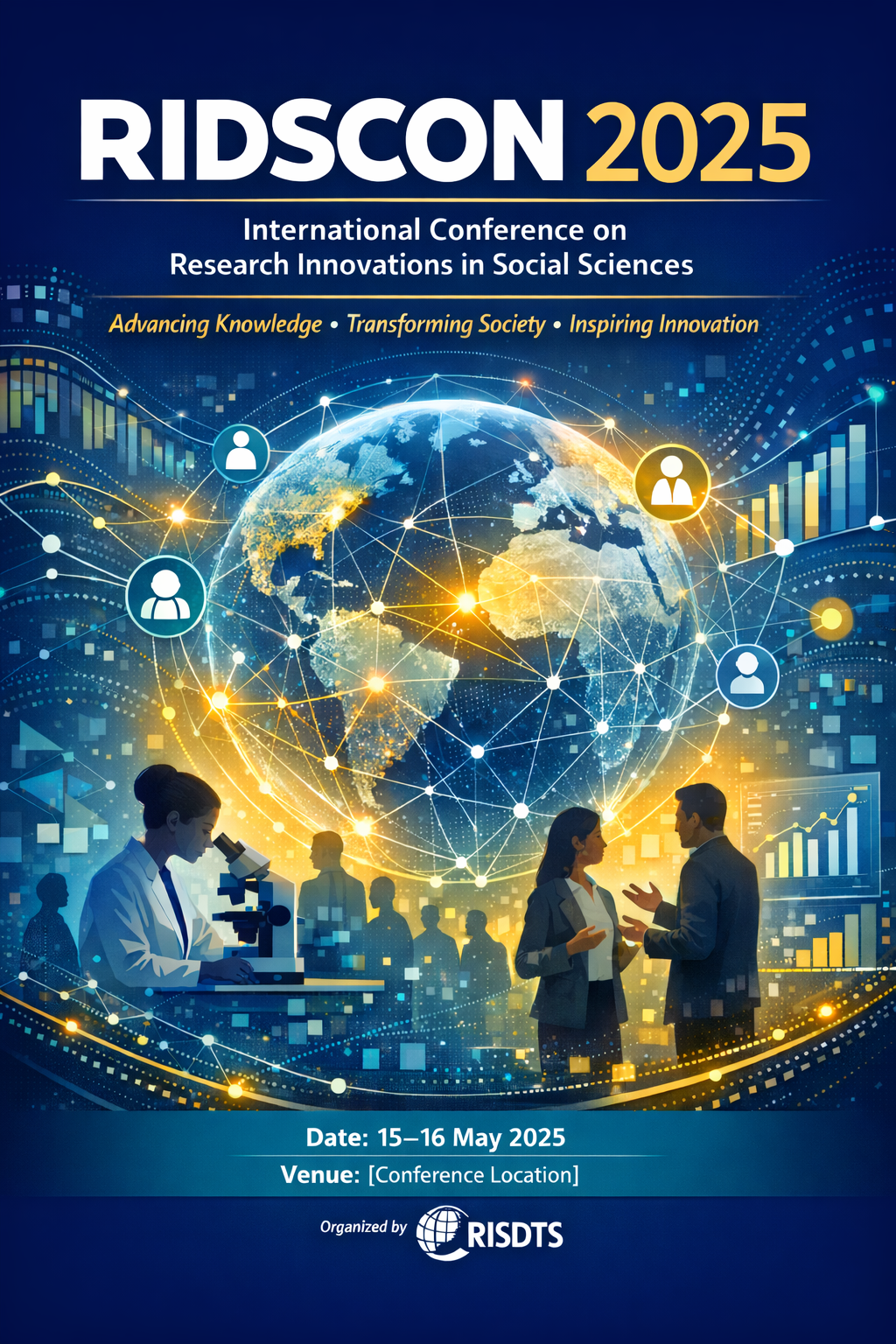
Copyright (c) 2025 RIDSCON – International Conference on Research Innovations in Social Sciences

This work is licensed under a Creative Commons Attribution 4.0 International License.